Mexican Slang: 12 Words You'll Hear Every Day in Mexico
Learn the Mexican slang locals actually use, from güey and neta to no manches and aguas, with example lines, a self-test quiz and a free cheat sheet.
Nativia Team
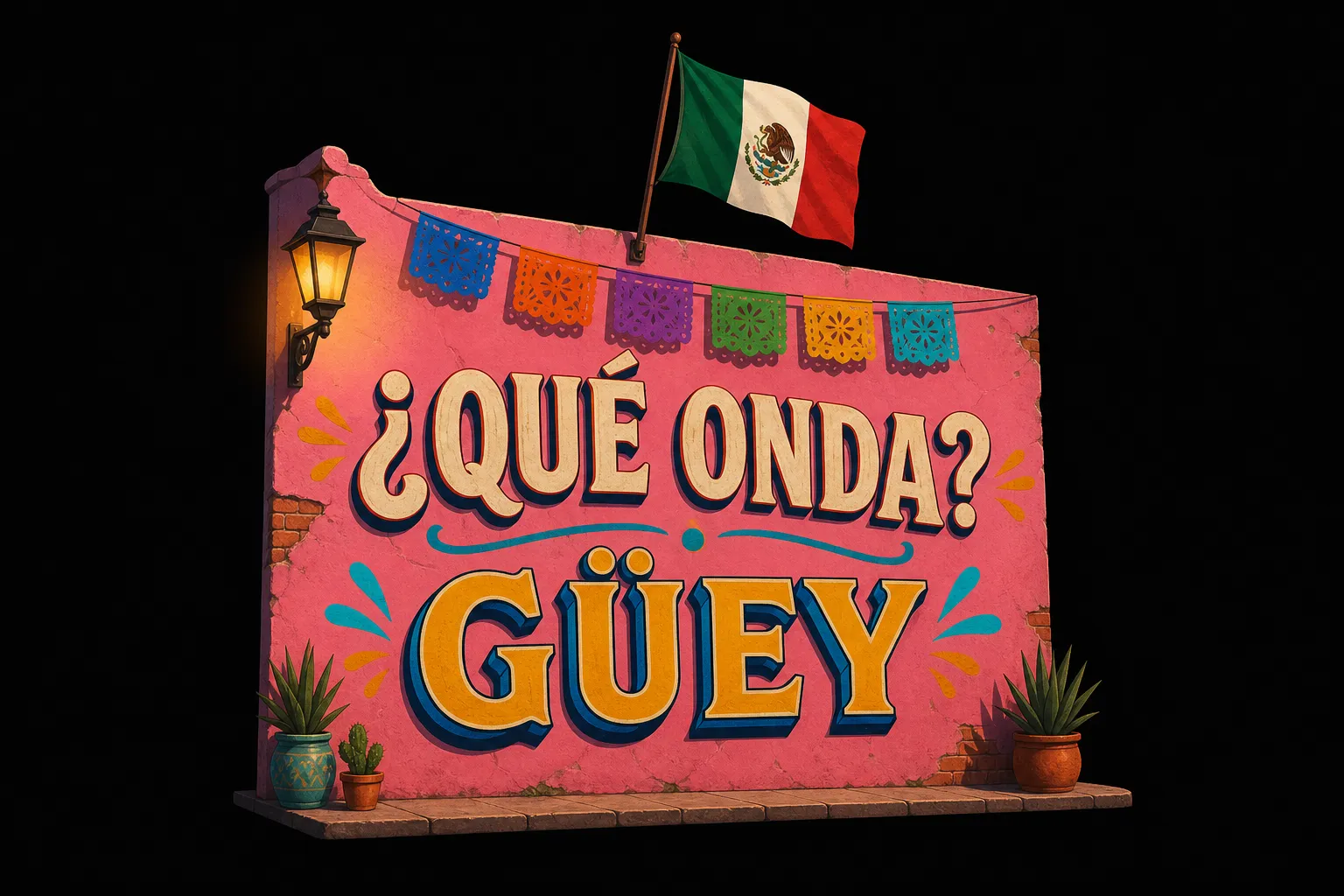
My first week in Mexico City I understood maybe half of what my roommates said. Not because their Spanish was fast. Because every third word was something no textbook had ever shown me.
Here are the 12 words that closed that gap. Each one comes with its standard Spanish base, an example line, and a note on where else it works, because several of these mean something completely different two borders away.
Quiz ahead: At the end of this article a short quiz tests you on real dialogue lines. Question 4 catches almost everyone who has only visited Spain.Greetings and reactions
1. ¿Qué onda?
Literally "what wave?", in practice "what's up?". This is the default casual greeting among friends.
¿Qué onda, cómo te fue en el examen? (What's up, how did the exam go?)
Standard Spanish: ¿Qué tal? Used in Mexico, Argentina and Chile. In Spain it sounds foreign. ¿Qué pedo? is the rougher version. Only use it with close friends.
2. Güey
Pronounced "way". It means dude, mate, or sometimes idiot, depending entirely on tone. You will hear it ten times per minute in any group of friends.
No, güey, el metro ya cerró. (No, dude, the metro already closed.)
3. Neta
Truth. As a question, "seriously?". As a statement, "honestly".
¿Neta vas a renunciar? (Seriously, you're going to quit?)
La neta, no me gustó la película. (Honestly, I didn't like the movie.)
Standard Spanish: la verdad or en serio. Mexico only.
4. No manches
"No way!" or "you've got to be kidding". It expresses surprise, disbelief or annoyance, all with the same two words.
¿Perdiste el vuelo? ¡No manches! (You missed the flight? No way!)
It is the polite version of no mames, which is vulgar. Stick with no manches until you know the room.
5. Órale
The Swiss army knife. It means "okay", "let's go", "wow", or "hurry up". The tone does the work.
¿Vamos por tacos? Órale. (Shall we get tacos? Sure.)
¡Órale, qué casa tan grande! (Wow, what a big house!)
Standard Spanish: vale (Spain) or dale (Argentina). Mexico and Mexican-American communities.
Describing things
6. Chido
Cool, great, nice. The Mexican equivalent of chévere in Colombia or guay in Spain.
Está chido tu departamento. (Your apartment is cool.)
Padre does the same job and is a bit more family friendly. ¡Qué padre! means "how cool!", not "what a father", which is exactly what I thought the first time.
7. Fresa
Literally strawberry. Describes a posh, preppy, slightly snobby person or thing.
Esa fiesta estuvo muy fresa, puro vino y nadie bailó. (That party was really posh, only wine and nobody danced.)
Standard Spanish: pijo in Spain, cheto in Argentina, gomelo in Colombia.
8. Chamba
Work or a job. Also the verb chambear, to work.
Mañana no puedo, tengo chamba. (I can't tomorrow, I have work.)
Standard Spanish: trabajo. Also understood in Peru, Colombia and much of Central America.
9. Chela
A beer. Caguama is the big one-liter bottle.
¿Nos echamos una chela después de la chamba? (Shall we grab a beer after work?)
Standard Spanish: cerveza. Works in Mexico, Peru and Bolivia. In Spain say caña for a small draft.

Reading is step one. Speaking is what makes it stick.
Practice this in a real conversation, with instant feedback.
Warnings and time
10. Aguas
Literally "waters". It means "watch out!" and dates back to people shouting it before tossing dirty water out of windows.
¡Aguas con el escalón! (Watch out for the step!)
Standard Spanish: ¡cuidado! Mexico only. Say it in Buenos Aires and someone will hand you a glass.
11. Ahorita
The diminutive of ahora (now). It can mean "right now", "in a bit", or "possibly never". Context and tone decide, and even Mexicans joke about it.
Ahorita te lo mando. (I'll send it to you in a bit.)
Watch out:
- In Mexico, ahorita usually means later, sometimes much later.
- If you actually need something now, say ahora mismo or ya.
12. Mande
The Mexican way to say "pardon?" or "yes?" when someone calls your name or you didn't hear them.
Mamá: ¡Diego! Diego: ¿Mande? (Mom: Diego! Diego: Yes?)
Standard Spanish: ¿cómo? or ¿perdón? Using ¿qué? on its own sounds rude in Mexico. In Spain, mande sounds old-fashioned and servile, so switch back to ¿cómo? across the Atlantic.
Key takeaway:
- Greetings and fillers (güey, órale, neta) are what make you sound local, so practice them out loud in real sentences.
- Vulgar cousins exist for several words (no mames, qué pedo). Learn to recognize them, but let Mexicans use them first.
Test yourself
Read each dialogue line and pick what the slang word means.
Pick the meaning or the right word for each line, then check your answers.
1.A friend says: ¡Aguas, viene un coche! What are they telling you?
2.¿Nos vemos en la plaza? Ahorita no puedo.
Shall we meet later in the square? I can't right now.
3.Your boss asks: ¿Tienes mucha chamba hoy? What are they asking?
4.Someone calls your name in Mexico City. The polite reply is:
5.¿ te vas a mudar a Oaxaca? No lo puedo creer.
Seriously, you're moving to Oaxaca? I can't believe it.
6.A friend says: Esa cafetería está muy fresa. What do they mean?
Mexican slang cheat sheet
12 Mexican slang words at a glance
| Word | Meaning | Standard Spanish | Where it works |
|---|---|---|---|
| ¿Qué onda? | What's up? | ¿Qué tal? | Mexico, Argentina, Chile |
| Güey | Dude, mate | Amigo, tío | Mexico only |
| Neta | Truth, seriously | La verdad, en serio | Mexico only |
| No manches | No way! | No puede ser | Mexico only |
| Órale | Okay, wow, let's go | Vale, dale | Mexico |
| Chido | Cool | Genial | Mexico (chévere in Colombia, guay in Spain) |
| Fresa | Posh, preppy | Presumido | Mexico (pijo in Spain, cheto in Argentina) |
| Chamba | Work, job | Trabajo | Mexico, Peru, Colombia, Central America |
| Chela | Beer | Cerveza | Mexico, Peru, Bolivia |
| Aguas | Watch out! | ¡Cuidado! | Mexico only |
| Ahorita | In a bit, later, maybe never | Luego, más tarde | Mexico (means now in some countries) |
| ¿Mande? | Pardon? Yes? | ¿Cómo? ¿Perdón? | Mexico (sounds servile in Spain) |
Learn how people actually talk
Textbooks won't teach you this. In Nativia, the characters speak with real accents and real slang. Start talking with them today.
FAQ
Is Mexican slang understood in other Latin American countries?
Partly. Thanks to Mexican TV and music, most Latin Americans recognize güey, chido and no manches, but they won't use them. Words like aguas and neta can confuse people outside Mexico.
Is güey offensive?
Between friends of similar age, no. It is as neutral as "dude". Directed at a stranger, an older person, or said in an angry tone, it means idiot. When in doubt, leave it out.
How do I practice slang without sounding like I'm trying too hard?
Use one or two words per conversation, not all twelve. Fillers like órale and neta blend in fastest. Rehearsing short exchanges out loud, for example ordering a chela and reacting with no manches, helps far more than reading lists. Nativia's conversation scenarios let you run those exact exchanges before you try them on a real Mexican.
Keep reading
Colombian Slang: 12 Words You'll Hear in Medellín and Bogotá
Learn 12 Colombian slang words locals actually use, from parce to guayabo, with real example lines, where each is used, a quiz and a free cheat sheet.
12 Mexican Slang Words You'll Actually Hear Every Day
Learn 12 Mexican slang words locals really use, from güey to ahorita, with real dialogue lines, cross-country warnings, and a quick self-test quiz.
Spain Slang: 12 Words You'll Hear Every Day in Madrid
Spain slang locals actually use: tío, vale, flipar, currar and 8 more, with real examples, a quiz and a free cheat sheet. Watch out for the coger trap.