Saber vs Conocer: Two Ways to Say 'Know' in Spanish
Saber vs conocer explained with real examples, the traps that catch English speakers, a quick self-test and a downloadable cheat sheet for Spanish learners.
Nativia Team
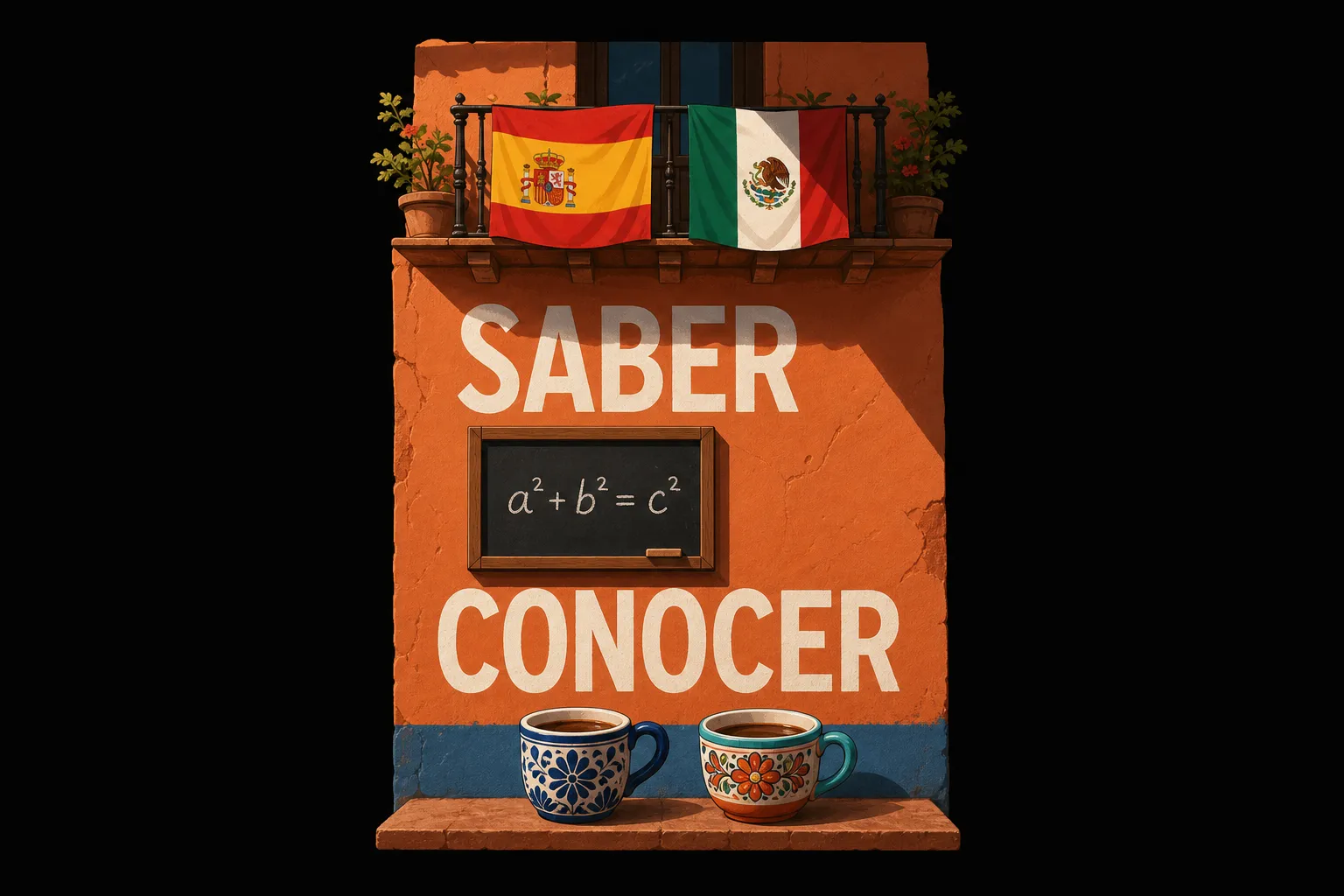
English gives you one verb for everything: you know a fact, you know a city, you know your neighbor. Spanish splits that job between two verbs, and picking the wrong one does not just sound off. It can change what you are saying.
Quiz ahead: A six-question self-test waits at the end of this article. Question 4 catches almost everyone who learned the rule from a textbook.Saber: facts, information, and skills
Saber is for things that live in your head. Facts, data, answers, and anything you can explain or do.
Use it when you could replace "know" with "know that," "know how," or "know whether."
- Sé que el tren sale a las ocho. (I know that the train leaves at eight.)
- ¿Sabes dónde está la farmacia? (Do you know where the pharmacy is?)
- Mi hermana sabe cocinar paella. (My sister knows how to cook paella.)
Notice that last one. Saber followed directly by an infinitive means "know how to." No extra word for "how" is needed. Sabe cocinar is complete.
One spelling trap: the yo form is sé, with an accent. Without it, se is a completely different word.
Conocer: people, places, and familiarity
Conocer is for things you know from experience. People you have met, places you have been, works you have read or heard. The word "familiar" is your clue. If you could say "I'm familiar with," you want conocer.
- Conozco a tu primo. Trabajamos juntos. (I know your cousin. We work together.)
- ¿Conoces Medellín? Es preciosa. (Do you know Medellín? It's beautiful.)
- No conozco esa canción. (I don't know that song.)
Two mechanics matter here. First, the yo form is irregular: conozco, with a z that appears out of nowhere. Second, when the thing you know is a person, Spanish adds the personal a: conozco a María, never conozco María.
Key takeaway:
- Saber is information. You can state it, explain it, or do it.
- Conocer is acquaintance. You have been there, met them, or come across it.

Reading is step one. Speaking is what makes it stick.
Practice this in a real conversation, with instant feedback.
The traps that catch English speakers
"Do you know the song?" vs "Do you know the lyrics?"
The same noun can take either verb depending on what you mean. ¿Conoces la canción? asks if you have heard it. ¿Sabes la canción? asks if you can sing it from memory. The verb tells your listener whether you are talking about familiarity or stored knowledge.
The past tense changes the meaning
This is the one most learners never hear about. In the preterite, both verbs shift from a state to an event.
- Supe la verdad ayer. (I found out the truth yesterday.)
- Conocí a Laura en Sevilla. (I met Laura in Sevilla.)
If you want "I knew" as a lasting state in the past, use the imperfect: sabía or conocía. Say conocí a tu jefe when you mean "I knew your boss" and a native will hear "I met your boss," and then wait for the rest of the story.
Never put an infinitive after conocer
Conocer nadar is not a thing. Skills are always saber: sé nadar (I know how to swim). If you catch yourself about to say conozco cómo, stop. That is a word-for-word translation of "I know how," and it is wrong.
Watch out:
- Sé with an accent means "I know." Se without it is a pronoun.
- Conozco a Pedro needs the personal a. Dropping it marks you as a beginner instantly.
Test yourself
Pick the right verb in each sentence, then check your answers.
Choose the correct option in each sentence, then check your answers.
1.¿ a qué hora abre el museo?
Do you know what time the museum opens?
2.No a nadie en esta ciudad todavía.
I don't know anyone in this city yet.
3.Which sentence correctly says 'I know how to drive'?
4.Ayer que mi vuelo estaba cancelado.
Yesterday I found out that my flight was cancelled.
5.A friend asks: ¿Conoces Buenos Aires? What are they really asking?
6. a Carlos en una fiesta el año pasado.
I met Carlos at a party last year.
Saber vs conocer at a glance
Saber vs conocer at a glance
| Situation | Verb | Example |
|---|---|---|
| Facts and information | saber | Sé que llueve mañana. (I know it rains tomorrow.) |
| Question words: dónde, cuándo, qué | saber | No sé dónde vive. (I don't know where he lives.) |
| Skills, with an infinitive | saber | Sabe tocar la guitarra. (She knows how to play guitar.) |
| People, with personal a | conocer | Conozco a tu madre. (I know your mother.) |
| Places you have visited | conocer | Conocemos Lima. (We know Lima.) |
| Books, songs, films you have come across | conocer | Conozco ese libro. (I know that book.) |
| Preterite of saber | supe | Supe la noticia. (I found out the news.) |
| Preterite of conocer | conocí | Conocí a Ana. (I met Ana.) |
| Irregular yo forms | sé / conozco | Sé (accent), conozco (added z) |
Practice this grammar in real conversations
Rules only stick when you use them. Practice them in real conversations in Nativia and get instant grammar feedback after every message.
FAQ
Can I use saber with a person?
Not for knowing them. Sé quién es (I know who he is) is fine because you know a fact about him. But "I know him" is always lo conozco.
What is the difference between "no sé" and "no conozco"?
No sé means "I don't know" as in "I have no idea," and it works on its own as a full answer. No conozco needs an object: no conozco ese restaurante (I'm not familiar with that restaurant). If someone asks you a question and you have no answer, no sé is what you want.
Why does "conocer" sometimes mean "to meet"?
Because the preterite turns the state of knowing someone into the moment it began. Conocí a mi novio en Oaxaca (I met my boyfriend in Oaxaca) describes the first meeting. For "I knew him back then," switch to the imperfect: lo conocía.
Keep reading
Saber or Conocer? 7 Spanish Verb Pairs English Mixes Up
Saber vs conocer, pedir vs preguntar and five more Spanish verb pairs English speakers mix up, with fixes, memory hooks and a self test quiz.
Ser vs Estar: The Spanish Rule Nobody Explained to You
Ser vs estar finally explained: when Spanish uses each verb for 'to be', the common traps like aburrido and listo, a quick self-test and a cheat sheet.
Qué vs Cuál: When Spanish Has Two Words for 'What'
Qué vs cuál confuses every English speaker because both mean what or which. Learn the real rule, the noun trap, and test yourself with a short quiz.