The Island Method for Spanish: 5 Stories That Rescue Any Chat
The island method for Spanish explained: build 5 short personal monologues in 2 weeks so you always have something to say in a real conversation.
Nativia Team
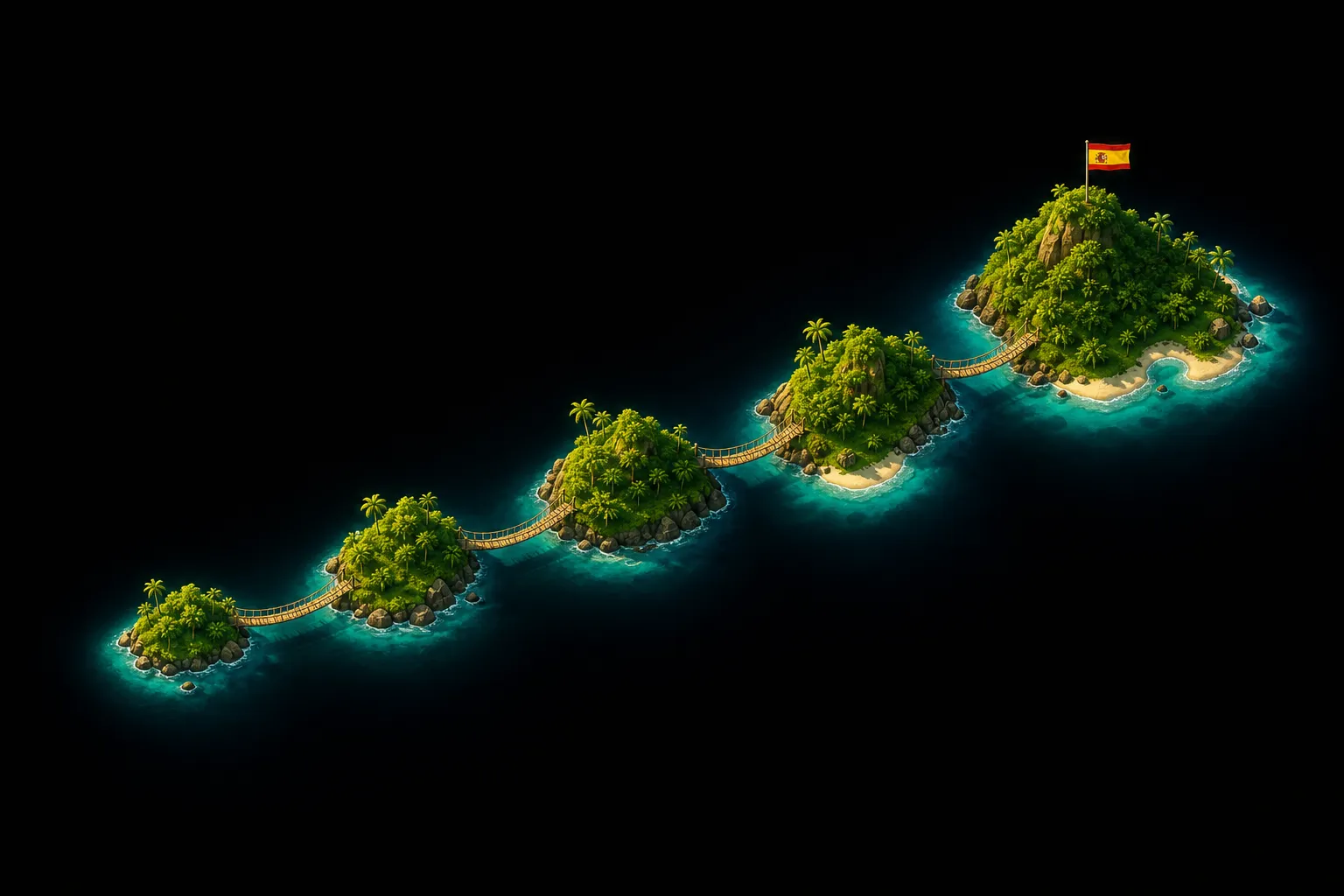
The first time a Colombian host asked me ¿Y tú qué haces? (And what do you do?), I had 800 flashcards in my head and nothing in my mouth. I knew the word for "engineer". I did not know how to be one for thirty seconds in Spanish.
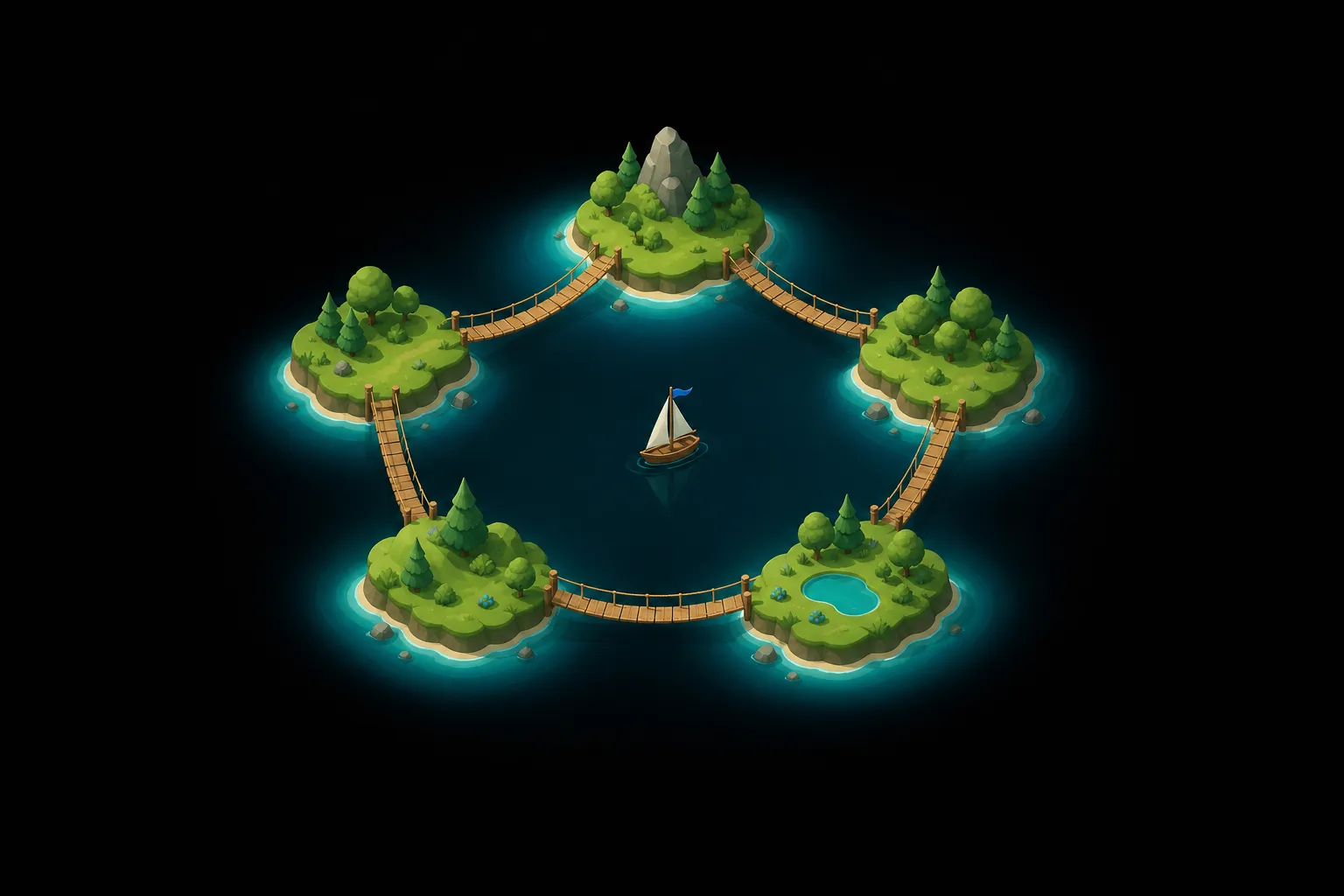
The island method fixed that. The idea comes from Boris Shekhtman, a teacher who trained US diplomats: instead of hoping vocabulary will assemble itself live, you prepare five short monologues about your own life, drill them until they are automatic, and steer every conversation toward one of them. You are never lost at sea, because there is always an island within reach.
Quiz ahead: A short quiz at the end checks whether you can spot the right island and the right bridge. Question 4 catches almost everyone.What an island actually is
An island is a 6 to 10 sentence story about one topic from your life. Not a vocab list, not a dialogue, a story you can tell in one breath. It uses only grammar you already control, so you can say it fast and without thinking.
The trick is that real conversations recycle the same 5 or 6 questions endlessly. Where are you from, what do you do, why Spanish, what did you do this weekend, what do you like here. If you own those answers cold, you sound fluent long before you are.
The five islands every learner needs
| Island | The question it answers | Grammar you need |
|---|---|---|
| Who I am | ¿De dónde eres? (Where are you from?) | ser, vivir, llevar + time |
| My work or studies | ¿A qué te dedicas? (What do you do?) | present tense, me gusta |
| Why Spanish | ¿Por qué aprendes español? (Why are you learning Spanish?) | porque, querer + infinitive |
| My last trip or weekend | ¿Qué hiciste el finde? (What did you do this weekend?) | preterite of 8 common verbs |
| Food and the local city | ¿Qué te gusta de aquí? (What do you like about here?) | me encanta, comparisons |
Pick these five first. Later you can add a sixth for your hobby or your family, but five covers roughly 80 percent of small talk with strangers.

Reading is step one. Speaking is what makes it stick.
Practice this in a real conversation, with instant feedback.
Week 1: build and fix your islands
Budget 20 minutes a day. One island per weekday, weekend for repairs.
- Write it in English first, 6 to 10 sentences. Boring is good. Real details beat clever ones: your actual street, your actual job.
- Translate it yourself, badly. Do not use a translator for the whole text. Use a dictionary for single words only, so the sentences stay at your level.
- Get it corrected. A tutor, a native friend, or an AI corrector. Ask for the simplest correct version, not the most elegant one.
- Read it aloud three times while recording yourself on your phone.
Here is my "why Spanish" island at A2, after correction:
Aprendo español porque mi novia es de Medellín. (I am learning Spanish because my girlfriend is from Medellín.) Llevo ocho meses estudiando, más o menos. (I have been studying for eight months, more or less.) Al principio usé muchas apps, pero no hablaba nada. (At first I used a lot of apps, but I did not speak at all.) Ahora practico conversaciones todos los días y entiendo mucho más. (Now I practice conversations every day and understand a lot more.) Mi meta es hablar con su familia sin traductor en Navidad. (My goal is to talk with her family without a translator at Christmas.)
Five sentences, three tenses, zero subjunctive. That is an island.
Week 2: drill, then deploy
Now the islands stop being text and become reflexes.
- Days 8 to 10: shadow your recordings. Play the corrected audio (your tutor's, or a text-to-speech version), speak over it, match the rhythm. Five minutes per island, two islands per day.
- Days 11 to 12: say them without the text. Set a timer for 30 seconds per island. If you stall, you have found the sentence to simplify.
- Days 13 to 14: use them in a real conversation. This is the step most people skip. In Nativia, open a scenario like meeting a new coworker or chatting with a host, and steer toward your islands. The AI will ask the follow-up questions a real person would, and that is exactly the practice you need: landing an island, then surviving what comes after it.
If you have a language exchange partner, do the same thing with them. The point is not to recite. The point is to notice which island works and which question you still cannot handle.
Don't just memorize it. Say it out loud today.
Nativia turns what you just read into real conversations.
Bridges: how you get to an island
A bridge is a short phrase that turns any question into a chance to tell your story. Learn these cold and the method becomes nearly unbreakable.
Hablando de eso, el año pasado fui a Oaxaca. (Speaking of that, last year I went to Oaxaca.) Pues, en mi caso, trabajo desde casa. (Well, in my case, I work from home.) Es curioso, porque justo por eso aprendo español. (It is funny, because that is exactly why I am learning Spanish.) La verdad, lo que más me gusta de aquí es la comida. (Honestly, what I like most about here is the food.)
Someone mentions traffic? Hablando de eso takes you to your trip island. Someone complains about their boss? Pues, en mi caso opens your work island. Nobody notices, because native speakers do the exact same thing.
Key takeaway:
- Islands give you content you can say fast, with grammar you control.
- Bridges give you a way to reach that content from any question.
- Real conversation practice is what turns both into reflexes.
Self-test: islands and bridges
Pick the right option, then check your answers.
Pick the best option for each situation, then check your answers.
1.A stranger at a party asks: ¿A qué te dedicas? Which island do you pull out?
2.Hablando de eso, el año pasado a Medellín.
Speaking of that, last year I went to Medellín.
3.Which phrase pulls the conversation toward one of your islands?
4.Llevo años viviendo en Ciudad de México.
I have been living in Mexico City for two years.
5.Me la comida callejera, sobre todo los tacos.
I love street food, especially tacos.
6.Myth or reality: memorized islands make you sound robotic.
The 2-week island plan at a glance
Island method for Spanish: 2-week plan
| Island | Opening line | Bridge to get there |
|---|---|---|
| Who I am | Soy de Chicago, pero vivo en Madrid desde enero. (I am from Chicago, but I have lived in Madrid since January.) | Pues, yo... (Well, I...) |
| My work or studies | Trabajo en marketing para una empresa pequeña. (I work in marketing for a small company.) | Pues, en mi caso... (Well, in my case...) |
| Why Spanish | Aprendo español porque quiero hablar con la familia de mi novia. (I am learning Spanish because I want to talk with my girlfriend's family.) | Es curioso, porque justo por eso... (It is funny, because that is exactly why...) |
| My last trip or weekend | El finde pasado fui a la playa con unos amigos. (Last weekend I went to the beach with some friends.) | Hablando de eso... (Speaking of that...) |
| Food and the local city | Lo que más me gusta de aquí es la comida. (What I like most about here is the food.) | La verdad... (Honestly...) |
Make speaking practice a daily habit
Nativia turns practice into an interactive story you'll want to come back to every day.
FAQ
Is the island method only for beginners?
No. Beginners use it to survive small talk. Intermediate learners build longer islands about opinions, work problems, or a film they watched, which forces the subjunctive and connectors into automatic use. The level changes, the mechanism does not.
How long should each island be?
Thirty seconds spoken, which is roughly 6 to 10 sentences. Longer than that and people interrupt, which is fine, but the part you have not drilled yet is where you will stall.
What if someone asks a question outside my islands?
Answer in one or two sentences, then bridge. No sé mucho de eso, pero hablando de viajes... (I do not know much about that, but speaking of travel...) is completely natural. Over time the gaps between islands shrink until the sea is mostly land.
Keep reading
Learn Spanish in 20 Minutes a Day: A Weekly Plan That Works
A realistic plan to learn Spanish in 20 minutes a day: a fixed daily block, a weekly rotation, and a speaking habit you can keep for months.
Talk to Yourself in Spanish: A 3-Week Plan That Builds Fluency
A 3-week self-talk plan to learn Spanish speaking at home: daily narration drills, realistic time budgets, and how to get feedback so mistakes don't stick.
The Shadowing Method for Spanish: A 4-Week Plan That Works
Learn the shadowing method for Spanish step by step: a realistic 4-week plan with daily 15-minute sessions that fix your accent, rhythm and speaking speed.